
POLYMATH: BREADTH WITH PURPOSE
I DON’T COLLECT DISCIPLINES. I CONNECT THEM.
POLYMATH THINKING, IKIGAI AND MY REASON FOR BEING
A specialist develops deep expertise within a particular field. A polymath develops expertise across different fields—and understands how to connect them.
That distinction matters because the most difficult business problems do not arrive neatly packaged inside one function. They sit between strategy and execution, leadership ambition and customer behaviour, technology and human adoption, creativity and commercial reality.
A specialist can solve the problem within their discipline. A polymath can recognise when the real problem exists between disciplines.
That is where I have built my career.
I have worked across B2C and B2B businesses, connecting retail, e-commerce, telecommunications, healthcare, SaaS, AI, customer experience, marketing, operations and commercial transformation.
These are not unrelated chapters in my career. They are interconnected perspectives that allow me to understand a business as a complete system.
I can listen to a leadership team discussing growth, understand the customer behaviours shaping that opportunity, decode the operational and technological barriers, imagine a better future state and work with multidisciplinary teams to build and deliver it.
This is why I describe myself as both an architect and a builder.
I create the strategic blueprint—but I also understand what must happen across people, processes, technology, data, customer experience and commercial execution to make it real.
IKIGAI: A REASON FOR BEING
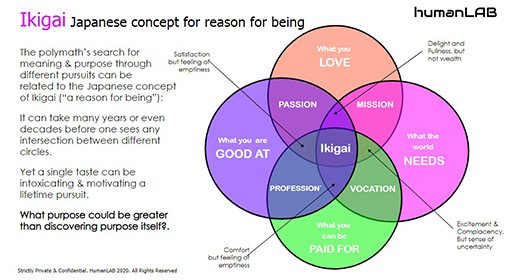
The Japanese concept of Ikigai can be translated as ‘a reason for being’—the source of meaning and direction that makes life feel worthwhile.
For me, Ikigai is not a formula for finding one perfect job. It is a way of understanding how different experiences, capabilities and interests can gradually converge into a meaningful purpose.
WHAT I LOVE: Solving complex problems, challenging conventional thinking and creating better experiences for customers, employees and organisations.
WHAT I AM GOOD AT: Listening to different perspectives, decoding complexity, recognising connections others may miss and turning ambiguity into a clear, practical path forward.
WHAT ORGANISATIONS NEED: Transformation that is human, commercially grounded and executable—not another strategy that looks impressive but cannot survive contact with operational reality.
WHAT CREATES VALUE: Architecting and delivering change across customer experience, digital commerce, AI, technology, marketing, operations and organisational capability.
At the intersection of these areas is my professional purpose:
To understand complex systems, connect the disciplines around them and build transformation that creates measurable human and commercial impact.
We listen to the ambition.
We decode the reality.
We imagine the right future.
We build what matters.
We mobilise the organisation.
We deliver measurable impact.
I am not defined by one industry, function or discipline. I am defined by my ability to connect them.